Herpetological trip to Peruvian Amazonia, NE Peru
6th - 24th of July 2013
Unless specified otherwise, all pictures © of Jeroen Speybroeck.Make sure you also check out Bobby's report.
Content
! Warning – this report is very, very, very, annoyingly long. To help you surviving it, here are some shortcuts.* Introduction
* Team
* How we herped
* Itinerary and non-herpetofauna photos
* Herpetofauna overview and photos
* Species list
* Trip evaluation aka pseudoscience
* Acknowledgements
* References
Please feel free to get in touch if you have questions or spotted some error. Help to solve identification mysteries is especially appreciated!
Introduction
Since 1999 (and until recently), my travels focused mainly on the European herpetofauna, with the pleasant result of having seen all species of Europe (excluding a handful occurring only in former Soviet states). My mother’s hobby (snorkelling) brought me in 2011 to see just a handful of Egyptian lizards, while my girlfriend’s desire to see giant trees brought me a surprisingly species-rich summer trip to California (2011). A more dedicated trip followed to one of the herping hotspots of the USA (SE Arizona, 2012).The Amazon rainforest!
Since my trips to the US, I had become a regular visitor of FieldHerpForum (FHF). Reading posts from more exotic parts of the world, I started to long for a ‘wilder’ destination. Somehow, South America seemed most appealing. A number of Peruvian posts by Matt Cage provided the spark that made it all become more concrete (see links to Matt's posts at the end of this report and be amazed!). The large and colourful diversity of the herpetofauna depicted in those posts together with the possibility to search for some of the most charismatic herp species in the planet’s most iconic ecosystem, convinced me to travel to the same place. My family situation forced me to take the trip in July. Devon Graham from Margarita Tours and Project Amazonas was kind enough to organise a customised and dedicated fieldherping trip for us, including a stay at three different locations, each with their own different character and species composition.
A number of the observed animals will never be identified (in part because we omitted to take enough pictures of bellies and inner leg surfaces etc. of frogs...), but an approximate total species count delivers ca. 126 species. As always, some desiderata were not found (anaconda, boa constrictor, ...), but we were also very fortunate at times. Observations of Ecnomiohyla tuberculosa appear to be (very) rare. Finding a bushmaster (Lachesis muta) during our third night ever in any bushmaster habitat, was as thrilling as any herping experience can ever be. Such luck!
Like many trips, this trip also had an (extremely) unpleasant incident, but luckily all ended well. More about that further in my story.
More importantly, this was a spectacular trip which we will all remember for the rest of our lives. There is nothing quite like it and it is fantastic.
Team
I managed to persuade 3 European herpers/friends to join me – Frank Deschandol (F), Bobby Bok (NL), and Peter Engelen (B). Peter had some Asian jungle herping experience, but the rest of us were jungle virgins. Neither of us had ever been to South America before, so we were more than just curious.Devon set up a team of 3 Peruvian helpers for us – a cook (Gilberto), a general guide and translator (Luis), and a local herping expert (Edvin). We were very happy with all 3 of them. They were very good company, and especially Edvin was absolutely crucial for our herping results.

me, Gilberto (cook), Peter, Frank, Bobby, Edvin (herping guide) & Luis (general guide & translator) - © anonymous local man
How we herped
Our main activity was hiking trails every night. In rubber boots & with flashlights, through the often muddy trails, trying to see animals through the clouds of fog, sweat and mosquitoes. A great activity with great results, and entirely different than herping Europe or the US. Some trails were easy and well-maintained, others were invisible prior to the machete action of our guides.With the sun already down at 18h00, we would usually be in bed by 01h00. Day hikes were also made but more to everyone’s individual desire and ability. Bobby, Peter and I were somewhat knocked out by the pills we took to prevent malaria, while Frank by nature always is a non-stop herping machine.
At first, we brought animals back to camp to take arranged pictures the next morning, but after seeing how poorly some animals coped with a night in captivity, we photographed most on the spot.
Itinerary and non-herpetofauna photos


Brussels => Madrid => Lima => Iquitos => Santa Cruz


at Madrid airport – © Peter Engelen

some delay…

approaching Iquitos (see ‘Genaro Herrera, Peru’ in Google Earth) – © Bobby Bok


on the road to Mazán


waiting for the second boat ride in Mazán – © Peter Engelen
© Peter Engelen

Santa Cruz
We spent 4 nights at this camp. The accommodation (wooden cabins with mosquito-netted beds, a kitchen, showers, toilet) fitted our needs perfectly. The camp allows for plenty of hikes in primary rainforest and has a dam and pond right next to it. This pond proved to be a very interesting habitat, especially after dark, with numerous frog species calling and showing themselves. Special mention has to be made of my first ever crocodilian observations, the highly variable and colourful clown treefrogs, and the fantastic monkey frogs, with the main attraction being the friendly giant Phyllomedusa bicolor. The highlight of the first night was a striped forest tree viper (Bothriopsis bilineata) which was also found right in camp, at just ten or twenty meters from our beds. We hiked day and (mainly) night and after our 4 days here, we were already at more than 50 species. It was also already during our third night that we found what is surely the ultimate highlight of the trip and most likely one of the major highlights of all our herping careers – like nature’s little landmine, a calm and quiet Bushmaster (Lachesis muta) was lying all curled up right on the trail. Impossible to beat the joy of that moment!

arrival at Santa Cruz

Santa Cruz site and pond as seen in Google Earth


the cabin I shared with Bobby, early morning

the Santa Cruz pond was an excellent herp habitat with caiman, tree viper, and numerous frog species


kids in the kitchen

the site had a fierce guard

breakfast buddies


Edvin telling stories of herping adventures great and small - © Bobby Bok

and so it begins… - Frank and Bobby grabbing some critter during our first night hike

Megalobulimus sp.

entering primary rainforest with Peter

view from the house near the river

first part of the hike to the actual camp site


a chicken that needed to be washed

primary rainforest – dark, even at noon

tiny sunny spots may attract basking diurnal reptiles

© Frank Deschandol

© Frank Deschandol

Heliconia - © Frank Deschandol


trying to recover a snake the kids spotted


fun with giant monkey frogs

monkey frog hattrick - © Bobby Bok


© Bobby Bok

after a bite of Erythrolamprus reginae… - © Frank Deschandol


the most memorable moment of the trip – © Nina from NY

Edvin catching shushupe

this crazy fool carried the price animal for the remainder of the hike

2nd photoshoot before releasing the bushmaster

taking measurements

someone’s happy!

A very scary incident & an unscheduled stop in Iquitos
While I clearly want to stress that it took us no time to realise that our guide Edvin was a tremendous help in finding and catching animals, his slight lack of more professional herpetological knowledge did however have a nasty effect during what involuntarily became our final night in Santa Cruz. A snake very much resembling the calico snake (Oxyrhopus vanidicus) I had caught two nights earlier was found, while Bobby and I were again at the pond (frog boys vs. snake boys...). As I was told afterwards, Edvin identified the snake as the same species of calico snake, after which the snake was passed on until it bit Frank in the finger. The animal’s jumpy behaviour then made Peter realise that they had all failed to identify this snake as the coral snake it truly was – a beautiful, but surely venomous Micrurus hemprichii. Frank soon experienced a lot of pain and passed out for a while. Edvin and Luis tried to arrange for a boat to take Frank as soon as possible to an Iquitos hospital. Before reaching the city, Frank’s situation had deteriorated dramatically, up to the point where he could hardly breathe. The rest of us were forced to stay in Santa Cruz, helplessly waiting in terror. The next day, we felt huge relieve to hear that Frank’s situation had stabilised and that he was going to make it. We packed all our stuff and instead of going straight to the next camp, we all went back to Iquitos. Paying the hospital bills and related costs was quite a mess, but in the end and only one night later, we were reunited and able to leave for Sabalillo all together.Coral snakes look like friendly candy sticks, but they surely can be jumpy(!) when handled, with a bite full of neurotoxins. Other lessons learned the (very) hard way: if you go herping in a new area, learn as much as you can about the local snake fauna, never handle snakes barehanded in an area where you are insufficiently familiar with the local species (but use the common snake-handling tools), always be sceptical towards any identification, ...
Needless to say, this was a close call and we are very, very, very happy it ended so well.

carrying Frank to the boat – © Peter Engelen

still alive! – © Peter Engelen
Sabalillo
We left Iquitos at 3pm. Still somewhat shocked by the bite incident, we were really tired when arriving after dark at Sabalillo along the Río Apayacu, a rather small northern tributary of the Amazon river. This was the most primitive of our stays (e.g., bathroom = river, toilet = hole in the ground), but I loved it for its tranquillity. We stayed here for 4 nights. Here, we found our first Amazon Tree Boa (Corallus hortulanus) but could not catch it, our first 2 colourful species of tiny but much appreciated poison frogs (Ranitomeya spp.) and plenty of other species including the beautiful 'moss frog' Ecnomiohyla tuberculosa and the much desired Surinam Toad (Pipa pipa). The way we finally 'found' a gladiator treefrog (Hypsiboas boans) is both funny and memorable. After several days of herping, swimming, a nice visit to a local town and a memorable frisbee match with the children of the lodge’s keeper, we decided we’d like to move on to the final, more accommodating camp, Madre Selva.

departure point in Iquitos


Sabalillo as seen in GE


© Frank Deschandol


late arrival


Frank, Bobby and Anolis transversalis

© Frank Deschandol


© Peter Engelen


© Frank Deschandol


after another night hike… - © Peter Engelen

© Bobby Bok

© Bobby Bok


© Peter Engelen

© Peter Engelen

© Peter Engelen


that lovely time of day when mosquitoes become even more active

Bobby and Ranitomeya - © Peter Engelen


© Frank Deschandol


© Bobby Bok

Edvin says “hi” to Laura
Madre Selva
Because this site’s list of known species is the longest (surely biased by observer effects), we decided to spend most of our time here - 8 nights. This is the largest, most developed, site. During the 4 first nights, we shared the camp with a group of American students and their mentors (including Devon Graham). The 4 final days were much calmer, as we had the site all to ourselves – just the 7 of us (4 Euro boys + 3 Peruvian helpers). Herpwise, our high expectations were perhaps not entirely met, but we sure also had some fantastic herp encounters here. Highlights include the extremely cute Bolitoglossas, the Common Harlequin Toad (Atelopus spumarius), a lot more beautiful Hypsiboas frogs, numerous tree boas, Aquatic Coral Snakes (Micrurus surinamensis), a big fer-de-lance (Bothrops atrox), the cutest turtle in the world (matamata (Chelus fimbriatus)), and Peter finally managing to catch a huge Spectacled Caiman (Caiman crocodilus). Both before and after our time here, we had the pleasure of seeing a Green Iguana (Iguana iguana) along the larger rivers.

© Frank Deschandol


Bobby loves Bolito

Madre Selva hiking map – © Peter Engelen

Saguinus fucicollis

Casa Bob & Jer

finally, Frank made his dream come true and caught a croc

scary giants haunt the forest - © Peter Engelen

Cithaerias sp.


© Peter Engelen

“der Bushmeister”

tiny studio for Plica umbra


Madre Selva entrance & boat house


el equipo femenino peruviano


Peru vs USA


Bobby after soccer


© Frank Deschandol


© Frank Deschandol

© Bobby Bok

© Bobby Bok


© Peter Engelen

© Peter Engelen
A final night in Iquitos and back home
Because of a rather early flight to Lima, we had to spend our final night in Iquitos. A copious dinner and a crazy night out with our Peruvian friends Edvin and Luis made for the perfect end to an unforgettable trip.

garden of Hospedaje La Pascana with some frogs and geckoes



© Frank Deschandol


© anonymous waiter

© Frank Deschandol

© Frank Deschandol

© Frank Deschandol
Herpetofauna
Species are presented in taxonomic order. For a chronological and more comprehensive collection, I refer to my web album.Please feel free to get in touch if you have questions or spotted some error. Help to solve identification mysteries is especially appreciated!
AMPHIBIA
Urodela
PlethodontidaeBolitoglossa altamazonica (Amazon climbing salamander)
There are only 2 or 3 salamander species in the Iquitos region, belonging to a single genus of small, lungless salamanders with lots of species more to the north. Only seen at Madre Selva. I love the head and feet.


Not easy to tell apart from the former, but this species has a (even) shorter snout, shorter tail, and darker belly.


© Frank Deschandol
Anura
BufonidaeAtelopus spumarius (common harlequin toad)
This is a beautiful member of the genus of the harlequin toads, many of which are under severe threat from the chytrid fungus. Basically diurnal and usually found near small streams, sitting on the ground or on low leaves.


Rhinella dapsilis (sharp-nosed toad)
A sometimes beautiful orangy and smooth-skinned relative of the next species.

Rhinella margaritifera species complex (crested forest toad)
More than one species may be present in the region, including R. margaritifera, R. proboscidea and maybe more. This is a common inhabitant of the forest floor, but it also sits on leaves in the undergrowth at night. Some have crazy crests and spines. Affectionately called "Mickey Mouse toad" by some of us.


Rhinella marina (cane toad)
I am happy that I got to see my first of these monster giants in their natural range. Usually in clearings and somewhat disturbed habitats, rather than in the forest itself.

Rhaebo guttatus (smooth-sided toad)
A second rather huge toad species, but much less frequently seen. We saw just one (Sabalillo).


Amazophrynella minuta species complex
Fouquet et al. (2012a) attributed the Amazonian clade of Dendrophryniscus to a new genus, Amazonella, but as this name was unavailable, Amazophrynella was subsequently proposed (Fouquet et al., 2012b).
In Sabalillo camp, Bobby spotted the tiniest anuran (even if juvenile). According to Mr. Luis Alberto Giussepe Gagliardi Urrutia, this should be a juvenile of the margaritifera complex. However, skin texture, head shape and colours, lack of parotoid glands and lack of external tympanum seem to differentiate it from the (extremely numerous) margaritifera juveniles we saw. Furthermore, dorsolateral ridges are lacking, whereas the orange to reddish feet are present. It also looks very similar to some online pictures (e.g., at CalPhotos Berkley and on the website of Dr. Axel Kwet) as well as a picture by William W. Lamar used in Duellman (2005), all of which are attributed to Dendrophryniscus minutus. The coin has a cross-section of 25,75mm, so the animal is about 7,5mm (or 0,3 inch).


© Peter Engelen
Here's a tiny (but larger) margaritifera juvenile for comparison.

© Bobby Bok
Another juvenile margaritifera (also with dorsolateral ridges) can be found on Mike Pingleton's site. The latter does have quite similar colours, though...
Aromobatidae
Allobates femoralis (spotted-thighed poison frog)
Hard to tell apart from the next species. Allobates femoralis has more black on the ventral surface, as well as a white stripe coming halfway up the side of the belly.


Dendrobatidae
Ameerega hahneli (pale-striped Amazon poison frog)


Ameerega trivittata (three-striped poison frog)
The ca. 5cm 'giant' among the dendrobatids.

Ranitomeya amazonica
This tiny red hopping dot was found during daytime at Sabalillo. This animal most likely is not R. reticulata, but belongs to a morph of R. amazonica that mimics R. reticulata. Main difference are the width of the dorsal stripes and the way the red stripes fuse with the blue body lines. Furthermore, the patterning on the legs is unique: R. reticulata almost always has very fine bright blue “bubbles” on their legs, whereas R. amazonica tends to have larger spots that are irregular circles which are often less bright blue.


Ranitomeya uakarii
At first, incorrectly identified as R. duellmani. The latter is actually a name which has been placed in synonymy with R. ventrimaculata, while the more yellow-striped ventrimaculata morphs now belong to (at least?) R. amazonica and/or R. variabilis (see Brown et al. (2001) for comprehensive background reading; link in references at the end of this report).

Ranitomeya variabilis
During a night hike at Sabalillo, Peter (him again) pulled two leaves of one of the few low-hanging bromelias, and found the same number of these frogs, which immediately tried to hide themselves again. See what I wrote with R. uakarii for why this is not R. ventrimaculata (anymore).
Similar looking animals have been shown to belong to both R. amazonica and R. variabilis. As this find was at only 1,5km from the red-headed R. amazonica above, it is most likely that this is R. variabilis.


© Bobby Bok
Hemiphractidae
Hemiphractus helioi (Peruvian casque-headed treefrog)
Behold the amazing Gonzo frog! Not often seen, so beforehand I didn't dare to hope to find one of these. I was thrilled to grab one of a leaf at Santa Cruz during the same night we found our bushmaster.


Hylidae
Dendropsophus ?brevifrons (short-nosed treefrog)


Dendropsophus haraldschultzi (many-striped treefrog)
Just 2 were seen, both at Madre Selva. The whereabouts of the portrayed animal were kindly hinted to us by Devon.

? Dendropsophus leucophyllatus (clown treefrog)
Found in floating vegetation at Madre Selva, but particularly numerous along the edges of the pond at Santa Cruz. Great variability and lovely colours and pattern, but not that easy to tell apart from triangulum. In fact, those portrayed below might all be triangulum(?).


Dendropsophus marmoratus (Neotropical marbled treefrog)
Looks from above like a piece of bark, or something a bird might have dropped, but this cute little frog has surprising lower surface colours.


Dendropsophus parviceps (orange-shanked treefrog)


? Dendropsophus cf. parviceps
Imho, this guy looks too different (skin texture, body shape, ...) from the previous one to belong to the same species.

Dendropsophus triangulum (variable clown treefrog)
See what I wrote with leucophyllatus. Love them!


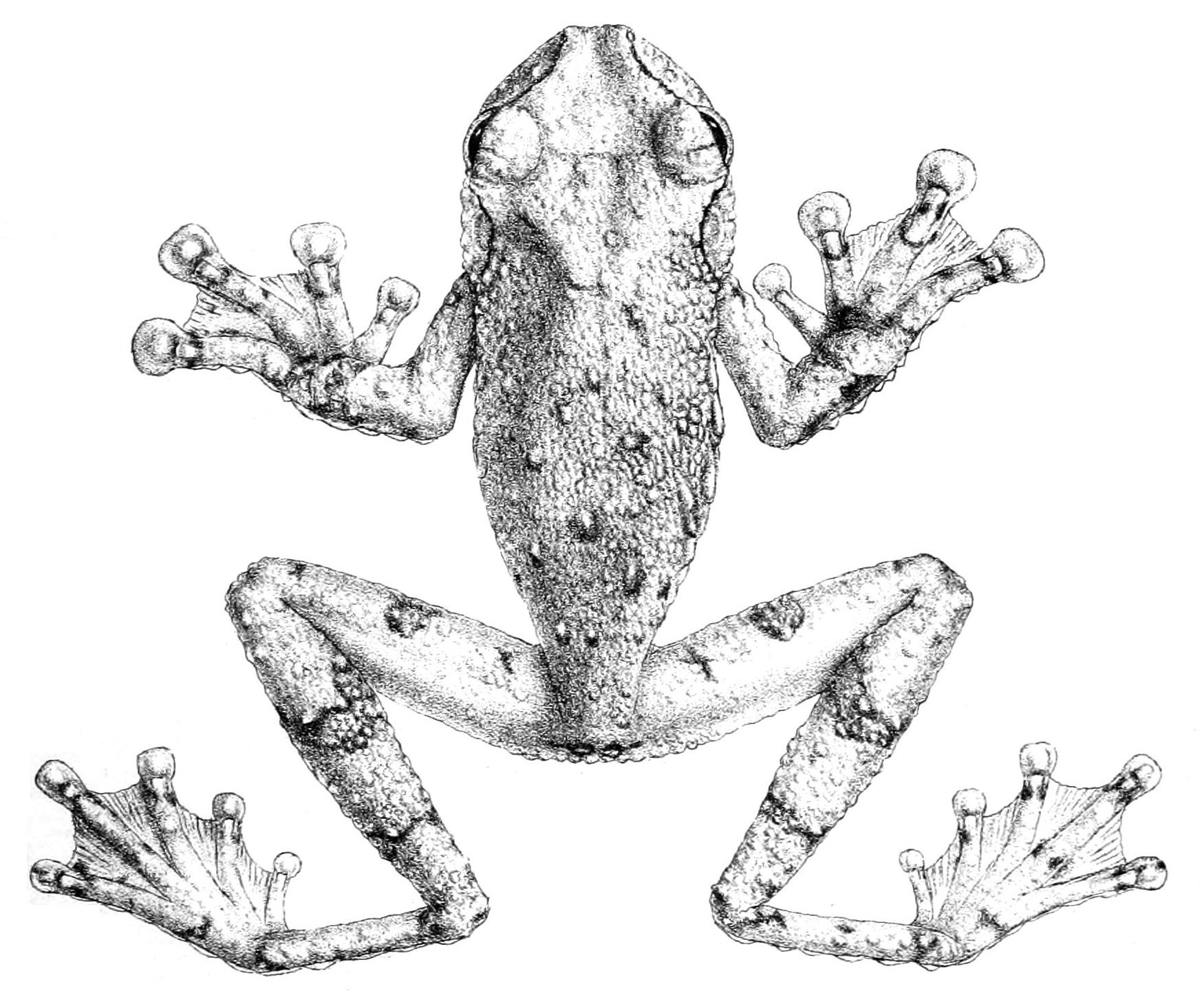
Ecnomiohyla tuberculosa
While Mr. Luis Alberto Giussepe Gagliardi Urrutia had me wondering if this could be a Osteocephalus cf. cabrerai, my initial identification was confirmed by Dr. William E. Duellman - this beautiful creature is the seldom observed Ecnomiohyla tuberculosa. The camouflage of this pretty and rather large "moss frog" is simply stunning.


Below is a marvelously accurate drawing from the original description (Boulenger, 1882), as available on Wikipedia. If you scroll all the way down, you will also find a link to the entire manuscript.
Hypsiboas boans (gladiator treefrog)
This was one of many species I had been particularly looking forward to see. Gladiator treefrogs were heard calling rather eratically, which made it hard to find one. An apocalyptical thunderstorm at Sabalillo, however, presented us with a gift. As Bobby jumped out of bed to save some luggage from the pouring rain along the edges of the lodge’s platform, a large frog was jumping between our bags. Another story of how the herp found the herper. This species lets you hear it when you are handling it not gently enough! According to Duellman (2005), exceptional in the fact that this species breeds in the dry season.


Hypsiboas calcaratus (convict treefrog)
I really love all the larger species of this genus, but this one surely is pretty. I remember Bobby saying at the small Madre Selva pond: "I think this is something else.". As more often than not, this kind of thought was followed by a very welcome addition to our observations.

Hypsiboas cinerascens (rough-skinned green treefrog)
This pretty frog was found when our spirits were down. After Frank and Peter got on the boat that would bring Frank to an Iquitos hospital, Bobby and I slowly hiked back to Santa Cruz camp in the pouring rain, as this little emerald gem jumped across the trail. The blue 'eyeliner' is stunning.


Hypsiboas fasciatus (spotted-thighed treefrog)
The competition is tough, but this is maybe one of the less attractive species of the genus.

Hypsiboas geographicus (map treefrog)
This species and the next were among the more commonly seen species of the genus. Imho, their colours and often weird dorsal pattern make them attractive frogs. The eyelid ornamentation is also really cool and is considered to help the resting frog to go unnoticed by predators.


Hypsiboas lanciformis (rocket treefrog)
Quite large and rather common. Once startled, it shoots off like an arrow at top speed, hence the name.


Hypsiboas microderma (yellow-toed treefrog)


? Hypsiboas cf. microderma


Hypsiboas nympha
A small and shiny jewel.

Hypsiboas punctatus (common polkadot treefrog)
Rather common in places where clown frogs also thrive, and yet another beautiful species.


Osteocephalus buckleyi (bony headed treefrog)

? Osteocephalus deridens (bromeliad treefrog sp.)
Identified as probably a female O. deridens by Mr. Luis Alberto Giussepe Gagliardi Urrutia.

? Osteocephalus lepreurii (common bromeliad treefrog)
While tentatively identified as O. cf. yasuni by Mr. Luis Alberto Giussepe Gagliardi Urrutia, Dr. W.E. Duellman considered this animal most likely to be O. lepreurii. Not sure at all, but after reading a little bit, I am following the latter opinion.

Osteocephalus planiceps (flat-headed treefrog)
Although I am not sure if all portrayed animals belong to this species, this was probable our most commonly spotted Osteocephalus.


Osteocephalus taurinus (giant broad-headed treefrog)
Beautiful eyes, which I shamefully omitted to photograph properly.

Osteocephalus (cf.) yasuni (Yasuni treefrog)
Identified as probably this species by Mr. Luis Alberto Giussepe Gagliardi Urrutia.


Osteocephalus sp. (bromeliad treefrog sp.)

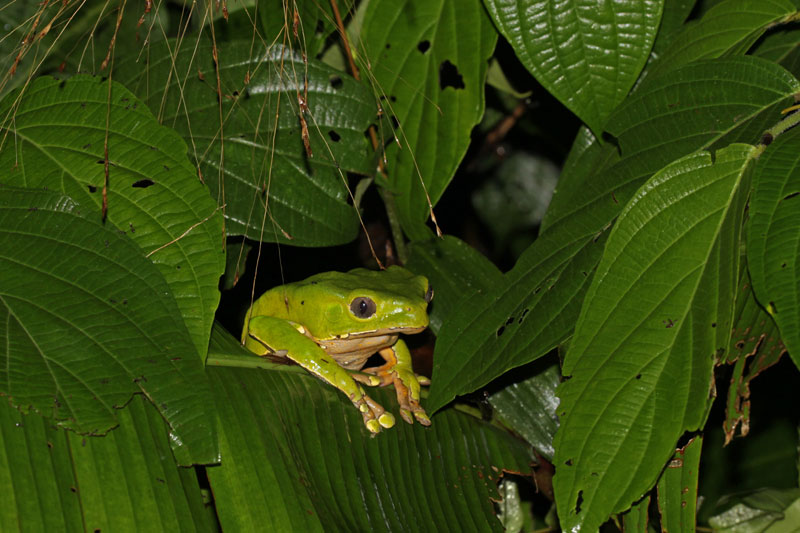
Phyllomedusa bicolor (giant monkey frog)
This is the king of the monkey frogs, equally slow and clumsy as lovable. We didn't expect to see so many, while the other monkey treefrogs were seen as just one individual of each. Plenty of these friendly giants around the Santa Cruz pond. What fun they are to watch and handle for a while. Usually solitary males call from up a tree, but in one banana plant, there was some sort of, albeit civilised, bar fight going on.


Phyllomedusa tomopterna (barred monkey frog)
Maybe the more beautiful of the three species.


Phyllomedusa vaillanti (white-striped monkey frog)
This one didn't seem to respond too well to a night in a jar, so we didn't bother it much longer.

Scarthyla goinorum (slender treefrog)
A tiny treefrog. Found just a single individual only, right outside the kitchen at Madre Selva. As I read afterwards in Duellman (2005), this species is so small that it is able to leap on top of the water surface without submerging.

? Scinax funereus (brown-thighed treefrog)
According to Dr. W.E. Duellman, the frog below probably belongs to this species.

Scinax garbei (fringe-lipped treefrog)
The fringed chin and warty skin make this species stand out from the other, rather hard to tell apart members of the Scinax genus, and a worthy competitor in cuteness with the famous Gonzo frog (see higher).


? Scinax ruber (two-striped treefrog)
While some surely do, animals portrayed below may not all belong to this species. Fourth animal was found in a bromelia in the small patio garden of Hospedaje La Pascana in Iquitos.
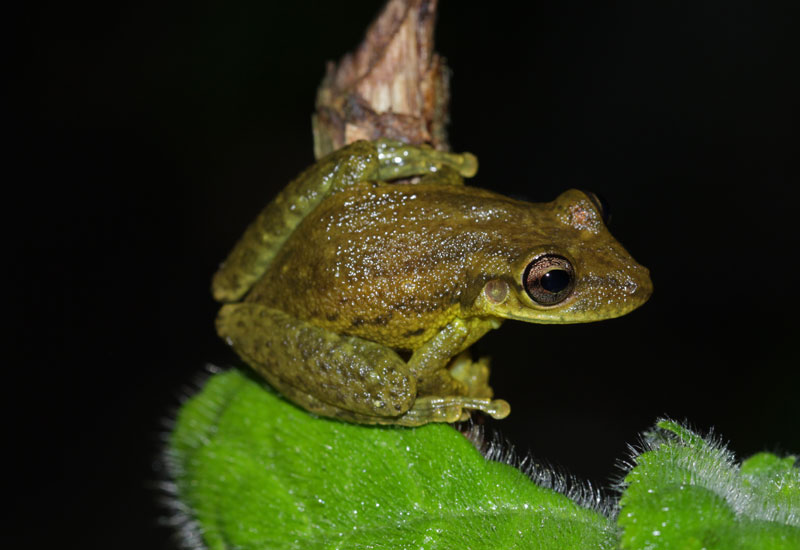


Sphaenorhynchus dorisae (spotted or lesser hatchet-faced treefrog)
I love how delicate and elegant this species looks. Usually on floating vegetation, but this one was found on a log in primary rainforest.
The metamorph in the second picture was identified as probably this species by Dr. W.E. Duellman, although the colour of the iris imho seems similar to that of a number of Hypsiboas species.


Sphaenorhynchus lacteus (greater hatchet-faced treefrog)
This one is also supposed to live on floating vegetation, but I found it in the exact same bromelia where I found a Scinax a little over a week earlier - the small enclosed garden of Hospedaje La Pascana in Iquitos. This was the final addition to our species list, after which we went into the city and behaved badly for just a little bit.


Trachycephalus resinifictrix (Amazonian milk treefrog)
Only saw this subadult.

Strabomantidae
Identifying members of the genus Pristimantis is a challenge, especially if you don't think of looking at (or photographing) all thinkable sides of each animal. Taxonomy is also still evolving. As a consequence, below are tentative identifications.
Pristimantis ?academicus ?carvalhoi


Pristimantis ?achuar ?luscombei ?lanthanites

Pristimantis altamazonicus (Amazonian rain frog)


Pristimantis ?conspicillatus (chirping rain frog)


© Bobby Bok

© Bobby Bok
Pristimantis ?croceoinguinis (antnest rain frog)


Pristimantis ???delius
To belong to this species, it shouldn't have the tubercles on the back, but the stripes and the large eye make it stand out from all other Pristimantis specimens we saw. But maybe martiae after all?

Pristimantis ?diadematus (diadem rain frog)

Pristimantis ?kichwarum ?ockendeni


Pristimantis lacrimosus (peeping rain frog)
It took us a while to figure out that this was not a treefrog.

Pristimantis ?malkini (Malkin’s rain frog)


Pristimantis ?martiae (Marti’s rain frog)


Pristimantis ?padiali
One of a few more colourful rain frogs and a pretty little thing it is! Reminded me in pattern a little bit of our European treefrogs. Yellow belly differentiates it from P. acuminatus.


Pristimantis peruvianus (Peruvian rain frog)


Pristimantis ?variabilis (variable rain frog)

© Bobby Bok
Strabomantis sulcatus (broad-headed rain frog)
The broad snout gives this distinctive species easily away.

Oreobates quixensis (common big-headed rain frog)
This is one of the more common species, found both day and night. Not particularly attractive, but I somehow like it's round, big head.


© Peter Engelen
Leiuperidae
This family might also be treated as part of the Leptodactylidae as Leiuperinae.
Edalorhina perezi (eyelashed forest frog)
You soon see that you found something new when you catch one of these. We found 3 or 4 very close together at Sabalillo (but none anywhere else).


Engystomops petersi (painted forest toadlet)
After suspecting numerous bufonid juveniles of belonging to this species, we found a couple close to where we found the previous species, as well as our single Ranitomeya reticulata.


Leptodactylidae
Adenomera andreae (?cocha? chirping frog) & A. hylaedactyla (?forest? chirping frog)
These two species are considered only definitely distinguishable by call, with habitat possibly serving as (obviously less reliable) circumstantial evidence, but there seems to be some contradiction on who’s who when comparing different sources of information.
Mike Pingleton informed me that A. andreae has a short snout (distance from eye to snout is about the diameter of the eye) and somewhat inconspicuous dorsolateral glands, while A. hylaedactyla has a well-defined set of dorsolateral glands and a longer snout (eye to snout is larger than diameter of the eye), but there seems to be some variability within these characteristics.
As difficult as it may be, I think both species were seen. I have grouped the pictures as such that the two first animals are from more open areas, while the last three are from inside primary rainforest. The last one had me fooled to be something else at first.


Leptodactylus discodactylus (dark-blotched whistling frog)
The genus Vanzolinius has been placed in synonymy with Leptodactylus (de Sá et al., 2005). The first animal, I wrongly considered "probably nothing new", hence the lousy picture. The second animal is more difficult to identify, but Mr. Richard D. Bartlett informed me that the animal looks most like Leptodactylus discodactylus.


? Leptodactylus leptodactyloides (common jungle frog)
Part of a species complex.

Leptodactylus pentadactylus (smoky jungle frog)
A famous, huge frog that may jump like a directionless bouncing ball. Single "woop" calls carry far through the forest.

? Leptodactylus petersii (Peter’s jungle frog)
Part of the same species complex as L. leptodactyloides.

Lithodytes lineatus (painted antnest frog)
This species is considered a mimic of poison frogs.

Microhylidae
Hamptophryne boliviana (Amazon sheep frog)
A single individual of this species became our only microhylid.

Pipidae
Pipa pipa (common Surinam toad)
Disappointing and boring to some, yet a true highlight for others, the latter including yours truly. I feel that there is nothing quite like a (living) animal that looks like it has been run over more than once. Together with a certain turtle (see below), strong evidence that Mother Nature has a healthy sense of humor.


REPTILIA
Crocodilia
AlligatoridaeCaiman crocodilus (spectacled caiman)
We saw only one species of crocodilian. Maybe we didn't focus enough on finding another. It was my first wild crocodilian ever, so I was more than happy with ‘just’ one species. First, we saw them at night in the Santa Cruz pond. Frank tried to catch one, but failed and lost a rather expensive flashlight while trying. In Madre Selva, we got some shots of one that was caught by an American guy, Chris(topher) Gillette, who has handled crocodilians a billion times. Towards the end of our trip, Peter saved the day by catching our very own gigantic caiman.


© Frank Deschandol
Chelonii
ChelidaeChelus fimbriatus (matamata)
The only turtle we saw, but an absolute, yet weird highlight. Caught in the small pond behind the kitchen at Madre Selva. I found it hard to look at that face and not start laughing.


 © Frank Deschandol
Sauria
SphaerodactylidaeGonatodes concinnatus (collared forest gecko)
I think we saw only one really colourful male of this species, and I believe it was the very first herp of the trip. A welcome sight while dragging a much too heavy backpack up the trail after 48hrs without any real sleep. We saw quite some more, but mostly females, which can be sometimes challenging to tell apart from the next species.

Gonatodes humeralis (bridled forest gecko)
This species also has males with beautiful colours.

Pseudogonatodes guianensis (Amazon pygmy gecko)
It was Bobby who first pointed out that this was not just an ugly juvenile Gonatodes.

Gekkonidae
Hemidactylus mabouia (tropical house gecko)
Apart from a single animal in the kitchen at Madre Selva, only seen (in abundance) in Iquitos, including in the La Pascana garden.

Phyllodactylidae
Thecadactylus solimoensis (turnip-tailed gecko)
A larger gekko with great feet. In Madre Selva, we had one in our cabin, doing its best to help us in the struggle against certain insects.


Gymnophthalmidae
Cercosaura ocellata (black-striped forest lizard)

Cercosaura argulus (white-striped eyed lizard)
The genus Prionodactylus has been placed in synonymy with Cercosaura, and Cercosaura oshaughnessyi is a junior synonym of C. argulus (Doan, 2003; Doan & Lamar, 2012).


© Bobby Bok
Iphisa elegans (glossy shade lizard)
I first took this animal for a juvenile skink. Thanks to Dr. Laurie J. Vitt for pointing out the true identity of this little lizard.

Potamites ecpleopus (common streamside lizard)


Ptychoglossus brevifrontalis
The transparent eyelid is diagnostic.

Hoplocercidae
Enyalioides laticeps (Amazon forest dragon)
The adult male dragon we found early in the trip taught us that a colourful animal found during a nocturnal hike can be (a little) less so during daytime.


Iguanidae
Iguana iguana (green iguana)
Large, but surprisingly hard to spot against a white sky. Usually seen rather high up in trees along the banks of the larger rivers. The second one was caught by a local guy.


Dactyloidae
Anolis bombiceps (blue-lipped forest anole)
We certainly saw a few more, but I only seem to have pictures of one.

Anolis fuscoauratus (slender anole)
The least conspicuous and most uniform species. Rather common.

Anolis ortonii (Amazon bark anole)

Anolis ?scypheus (yellow-tongued forest anole)
Formerly, a subspecies of Anolis chrysolepis. Following a 2010 ICZN ruling, the name chrysolepis has priority over nitens.


© Peter Engelen

Anolis tandai (blue-throated anole)
Formerly, a subspecies of Anolis chrysolepis. Following a 2010 ICZN ruling, the name chrysolepis has priority over nitens.


Anolis trachyderma (common forest anole)
Seemed to be the most common species.


Anolis transversalis (banded tree anole)
Quite large and attractive, but turns brown when disturbed. Beautiful blue iris.

Anolis sp.
Below are animals that are most likely trachyderma or fuscoauratus.


Tropiduridae
Stenocercus fimbriatus (western leaf lizard)
Not very rare, but very well camouflaged and fast. I had it staring at me for months from the cover of the Bartlett book, so it was a treat to see one in real life.


Plica plica (collared tree runner)
The most commonly seen of two species of tree runners. At night, much easier to approach.


Plica umbra (olive tree runner)
We saw just a single one.

Scincidae
Copeoglossum nigropunctatum (black-spotted skink)
Quite abundant along the edges of open spots, in piles of leaves in sunny spots, etc. Juveniles with a bright blue tail.


Teiidae
Ameiva ameiva (Amazon whiptail)
Regularly seen during the day in Santa Cruz camp, but quite shy. I took the animal in the second picture for a Kentropyx altamazonica, but was corrected by Dr. Laurie J. Vitt.


Dracaena guianensis (northern caiman lizard)
Peter spotted one swimming while kayaking at Madre Selva. He could approach it up to about 3m before it disappeared. Too bad… Naturally, Peter was severely punished afterwards.
Kentropyx altamazonica (cocha whiptail)
Seen more than once, but for some strange reason no picture.
Kentropyx pelviceps (forest whiptail)
This otherwise swift guy was prepared to stick to his leaf for a second (daytime!).

Tupinambis teguixin (golden tegu)
Usually observed as a huge black flash - taking off, never to return. Very shy. Dr. Laurie J. Vitt informed me that the animal in the second picture (from Madre Selva) seems to look more like Tupinambis longilineus. The first one is from Sabalillo but a little bit too far away for a 300mm.


running off with some fruit or meat from the kitchen - © Peter Engelen
Serpentes
BoidaeCorallus hortulanus (Amazon tree boa)
First picture shows our first one, very high up at Sabalillo. It wasn’t until Madre Selva that we could catch one. After several nocturnal trips along the river’s edge by kayak, this became our most often seen snake (8 individuals). Unfortunately, all were similar looking.


Epicrates cenchria (rainbow boa)
Strange things happen. This 1m70 snake was found in a ditch in the Mazán harbour, during the crazy frenzy when Frank was brought to the hospital. Hard to get a satisfying picture that has the entire animal in the frame...


Colubridae
Chironius exoletus (common whipsnake)
For reasons beyond comprehension, a certain someone thought it was a good idea to pull down the tree with this snake in as fast as humanly possible. Not a good idea with a fast-moving snake, so yet another silly story of failure…

Dendrophidion dendrophis (tawny forest racer)
I took just this in situ shot of this snake.

Drymoluber dichrous (common glossy racer)

Dipsadidae
Atractus ?major (giant earth snake)
This was a nice surprise to me, as I expected the members of this genus all to be rather unattractively coloured.

Atractus snethlageae (white-naped earth snake)
This snake was caught at night and bagged before anyone took a picture. Next morning, no snake in the bag anymore…
Dipsas catesbyi (ornate snail-eating snake)
During our first night, before Peter found a true highlight serpent (see green and cat-eyed critter below), I had the honour to catch the trip’s first snake. Later on, we found two more of these.


Drepanoides anomalus (Amazon egg-eating snake)


© Frank Deschandol
Helicops angulatus (banded Neotropical water snake)
Only one was found, which is less than we had expected.

Imantodes cenchoa (blunt-headed tree snake)
Only two were found, which is also less than we had expected. Both were found during the same night.


Erythrolamprus breviceps (tricolored swamp snake)

Erythrolamprus reginae (common swamp snake)
This one nailed my finger pretty good (see the Santa Cruz non-herp pictures above). Some annoying swelling followed, which lasted for a couple of days - nothing too serious.


Oxyrhopus vanidicus
Formerly considered part of (a.o.) O. melanogenys. Confusing this snake with a certain coral snake (see below) nearly killed Frank, yet I remember being pleased when I caught this colourful animal.


Pseudoboa coronata (Amazon scarlet snake)
I also liked this elegant and beautiful snake a lot, despite the fact that it was the worst snake to photograph for me so far. For this reason, I let someone with more solid nerves do the 'snake ikebana' (thanks, Frank!).


Xenopholis scalaris (flat-headed snake)


Elapidae
Micrurus hemprichii (orange-ringed coral snake)
So... this is NOT Oxyrhopus (melanogenys) vanidicus! An interesting read on the Reptile Database page of the latter species: "Etymology: Latin, meaning liar; used in allusion to the apparent mimicry of this species with the venomous coralsnake, Micrurus hemprichii.". This orange-ringed coral snake is surely beautiful, but it was nearly lethal for one of us. Frank’s condition was still unstable when I took a few rather lousy shots of an animal that scared us more than anything. Not a pleasant memory. First picture is in situ and was made by Peter.


Micrurus surinamensis (aquatic coral snake)
Took until Madre Selva and much longer than expected to find one of these. Given its beauty, well worth the wait. The first one was a big boy or girl, while I spotted a much smaller one in the small pond behind the kitchen afterwards.


Viperidae
Bothriopsis bilineata (striped forest pit viper)
A big highlight during our first night! After a snakeless hike, Peter spotted it right next to the cabin where Bobby and I were staying.


Bothrops atrox (South American or common lancehead, fer-de-lance)
Only three were seen. Frank brought in this larger one.


Lachesis muta ((South American or Amazon) bushmaster, local name: ‘shushupe’)
Without much doubt, the main target, as well as the main highlight of the trip. Finding this snake was a very, VERY happy moment. We wanted to find it sooo much, but did not have high hopes. Nearly everyone told us that it is really rare to find one, and that it often takes people many trips over years or even decades. It wasn’t huge (1m40), but we didn’t mind. As it was found curled up laying on the trail, it seems advisable not only to look up - nature's very own landmine. That being said, this animal behaved very calmly. During the same hike, we also found an exuvium of a much larger one (>2m).


Species list
THE LIST BELOW CONTAINS MINOR ERRORS AND NEEDS TO BE EDITED.A long, long, fantastic list comes with the countless pictures we were able to take. As indicated, not all species identifications are certain. For matters of species counting, I only considered animals which were (imho with sufficient certainty) not conspecific with any previously seen species. As such, the true number of observed species, especially when taking the frogs of the genus Pristimantis into account, is possibly slightly higher (but maybe somewhat lower) than what can be gathered from the list below.

Some species that did not make the list
* We found a skin that most likely belonged to an Amphisbaena alba (giant amphisbaenian).
* Hydrolaetare schmidti (moaning river frog) was heard calling occasionally, but the desire to find snakes and the scarceness of the calls ultimately kept us from seeing one.
* During our time at Madre Selva, Chris Gillette and Ed Metzger brought in two snake species we have not found ourselves: a Hydrops triangularis, and the Typhlops reticulatus shown below.

Trip evaluation aka pseudoscience
How to tentatively evaluate our results? Just for fun. After all, I am an obsessive list-and-numbers kind of guy. I apologise already for the nerdy nature of what you are about to read (or skip).Please note that the "final and true" numbers might differ from the ones I used below because of progress on solving certain pending identifications. Most likely, I will not redo the calculations, as the results would only be slightly affected and I am a lazy person.
Here we go.
A point of reference can be found in the results of Matt Cage’s team in January 2013. Of course, we have to consider some differences between both trips, listed in the table below (USA = Matt’s team; EU = our trip).

Additional factors include:
* all sorts of environmental variables (lunar phase, temperature, rainfall, ...)
* site differences & number of days per site
* individual searcher’s ‘talent’ and stamina (which usually tends to be lower on average in larger groups of herpetotourists)
* ...
But let’s, again just for fun, take a rough-and-dirty approach, by multiplying n° of days and n° of observers. This gives us an approximate estimate of search effort.
team USA = 11 * 20 = 220 person-days
team EU = 5 * 16 = 80 person-days
Hmmm... How should we understand the highly similar total species numbers, given the quite large difference in (roughly calculated) search effort?
Impact of number of sites & site differences ?
Admittedly, team EU did find a number of species (= 14) only at Sabalillo. However, all of these can also be found at both other sites. As far as the sites have been (unequally) investigated, the number of species occurring at only 1 or 2 of the sites seems low. So, would a similar number of additional species have popped up, if our time at Sabalillo would have been spent at one or both the other sites? Nobody knows... Yet, given the (in comparison with Europe and the USA) low “specimens/species” ratio (which I will re-address in a way below), I think the answer is “probably yes”.Impact of season ?
As certain canopy-dwelling frog species are known to be more obscure outside their breeding season, I expected for us to find less anuran species than the USA team. This proved to be wrong, as both trips yielded very similar numbers and percentages of amphibians (resp. USA 68 vs. EU 74, USA 54% vs. 59% EU). In contrast, we found less snake species, but I will get to that later. Overall, I get the impression seasonal differences have limited impact. Maybe this becomes less true when you move further away from the Equator - Duellman (2005) found only 5,2% (!) of anuran specimens in the dry season.Team ?
It has to be stressed that Edvin, our herping guide, was extremely good at finding and catching animals. Of course, we also did what we could, and Edvin would always stress that our results are a true team effort, but he really was a unique and extremely valuable asset. Also, among ourselves, not everyone is and was as tenacious. Similarly, the members of the USA crew did not all search equally hard and long, of course.No real answer to be found...? Let's look at some other details.
Composition differences
I will compare the species composition of both trips in two ways.Higher taxon composition
Let’s compare percentages of amphibians, snakes, lizards, and other reptiles.

As you can see, the portion of snakes was lower in our trip. An infinite list of possible explanations could be given. An often cited one might be lunar phase, as we did have a full moon during the trip, but who knows?
Species composition
A merely exploratory but useful way to calculate an indicator value for the similarity in both species lists is this (which I adapted from a formula for comparing biogeographical areas in Duellman, 2005):
2 * O / ( USA + EU )
with O = number of species in both lists; USA = number of species in USA list; EU = number of species in Europe list.
This yields a value between 0 and 1, with 0 being no overlap and 1 being complete overlap of the lists.
In this case:
2 * 91 / ( 126 + 125 ) = 0,73
Thus, the overlap is considerable, but not overwhelming.
Now let’s repeat this for snakes only.
2 * 12 / ( 21 + 27 ) = 0,5
This clearly shows a much smaller overlap.
Enough with the comparisons now! Let's dig some more into our own trip data.
Number of specimens per species
I mentioned it already: the “specimens/species” ratio is (very) low.Some examples:
* Of 44% of the anuran species, we only found a single animal. For snakes, this was even 68%.
* Only one snake species was found more than three times (Corallus hortulanus, n= 8). No snake species was found 10 times or more.
However, lizards seem to be a clear exception.

Species discovery rate
The fantastic book by Duellman (2005) on the herpetofauna of Cuzco Amazónico offers some more scientific reference on the subject. 141 of 152 known species were found in 992 days of search effort. More interestingly, a graph shows the cumulative number of anurans, lizards and snake species with increasing search effort, the latter expressed as total search time. A major difference with my considerations is of course that this is a single site, but let’s (again) ignore site effects.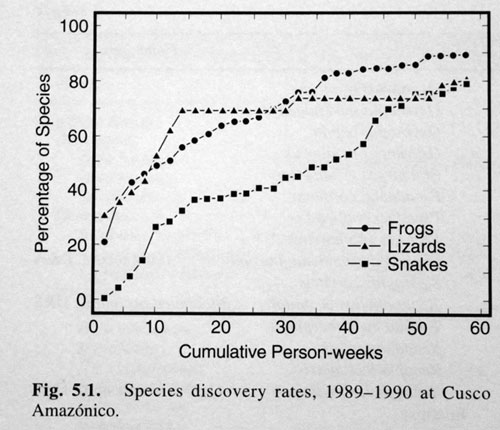
the graph from the fantastic Duellman (2005) book
It becomes obvious that more effort is needed to ‘complete’ the snake species list in contrast to that needed for those of both anurans and lizards. Also, while the number of anuran and lizard species heads more or less towards a plateau after a certain amount of search effort, this plateau did not seem obvious (yet) for the snakes.
I tried to make the same graph from our results. Of course, the 100% species list is not available, thus merely a 'guestimate' based on available information. Yet, at least the shape (slope) of the curves tells us something.
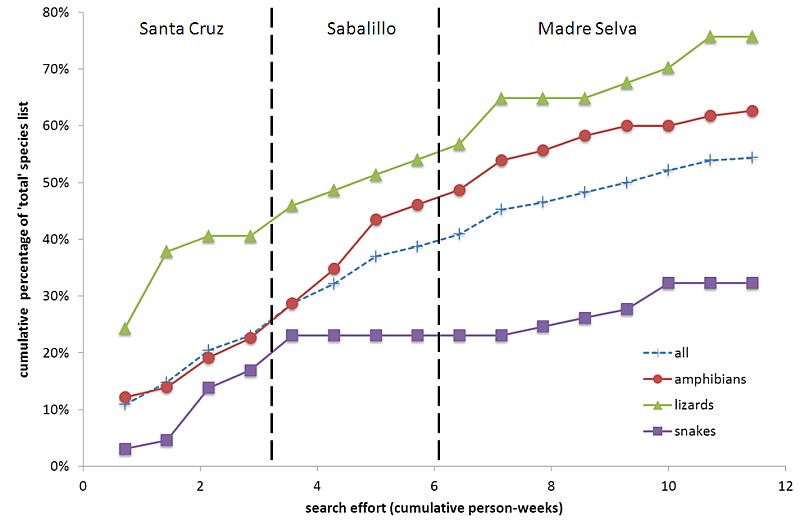
Note that the scale range along 'our' X-axis covers only a small portion at the left-hand side of the Duellman (2005) graph, and -again- that ours relates to three different sites, and not just one.
To my pleasant surprise, both graphs show some rather obvious similarities. During the first days, the number of observed lizard species seems to build up very quickly, while frog species accumulate more gradually. The first couple of snake species seem to come in quickly too, but then things slow down. If you look at the most left section of the Duellman graph, the fact that our final percentage of amphibian species is lower than that of lizard species also seems to fit, as it is close to the point where the lizard and frog graphs intersect in Duellman's graph (albeit Duellman considered anurans instead of amphibians, excluding only few species, so no big deal). Now comes the most interesting observation. While at 11-12 person-weeks (= our end point) the slope of lizard species in Duellman's graph is quite steep (= a lot of change within a small range of added search effort), overall percentages of species for all three subsets of species are quite similar. In conclusion, both graphs are strikingly similar. The only real dissimilarity might be the lag of snake species accumulation in our graph from about 4 to 7 person-weeks.
A final word on snakes
As expected, finding snakes was rather hard. Two weeks in Arizona brought us 96 live and 44 DOR snakes. We achieved similar results in Europe (e.g. 91 excluding the very abundant natricid species in Montenegro 2008). As such, it seems odd to find ‘only’ 38 snakes over 16 days in such a fantastic ecosystem. However, this seems to be in line with observations by other people – Edvin told us 2 snakes per night may be some sort of average. Our best night was one where we found 6 (including the amazing ‘shushupe’).Acknowledgements
For their help in the field and much more: our guides Edvin and Luis, and my three travel companions.For information prior to the trip: Matt Cage, Devon Graham, Mike Pingleton.
For their help identifying animals after the trip: Richard D. Bartlett, Manfred Beier, Jason Brown, Matt Cage, Christopher Carille, Dr. William E. Duellman, Mike Pingleton, John Sullivan, Evan Tworney, Luis Alberto Giussepe Gagliardi Urrutia, Dr. Laurie J. Vitt.
For lending me his copy of Duellman (2005): Bert Vandebosch.
References
An annotated checklist for the 3 visited lodges (2010) was provided to us by Devon Graham. While clearly somewhat outdated, this list served as the document on which we worked, noting what we saw where etc. While we were in Peru, our starting point for identifications was always the Bartlett & Bartlett (2003) book. For frogs and toads, Rodríguez & Duellman (1994) also got used a lot (see references below).We also had downloads of Matt Cage's FHF posts from 2012 and 2013 with us:
* Amphibians 2012
* Non-snake reptiles 2012
* Snakes 2012
* Amphibians 2013
* Non-snake reptiles 2013
* Snakes 2013
While we were there, we also used a number of (not entirely flawless) "rapid color guides" that are freely available online:
* Loreto (2010)
* Santa Cruz (2009)
Some more were consulted after the trip:
* Jenaro Herrera (2011)
* Kampankis (2012)
* Río Tahuayo (2012)
As a lot of papers are available online, I have inserted links wherever possible.
Bartlett RD, Bartlett P (2003) Reptiles and Amphibians of the Amazon: An Ecotourist's Guide.
Boulenger GA (1882) Catalogue of the Batrachia Salientia s. Ecaudata in the Collection of the British Museum. Second Edition. London: Taylor and Francis.
Brown JL, Twomey E, Amézquita A, Barbosa de Souza M, Caldwell JP, Lötters S, von May R, Melo-Sampaio PR, Mejía-Vargas D, Perez-Peña P, Pepper M, Poelman EH, Sanchez-Rodriguez M, Summers K (2011) A taxonomic revision of the Neotropical poison frog genus Ranitomeya (Amphibia: Dendrobatidae). Zootaxa 3083: 1-120.
D'Angiolella AB, Gamble T, Avila-Pires TCS, Colli GR, Noonan BP, Vitt LJ (2011) Anolis chrysolepis Duméril and Bibron, 1837 (Squamata: Iguanidae), revisited: molecular phylogeny and taxonomy of the Anolis chrysolepis species group. Bull. Mus. Comp. Zool., 160(2): 35-63.
Dixon JR, Soini P (1986) The Reptiles of the Upper Amazon Basin, Iquitos Region, Peru.
Doan TM (2003) A new phylogenetic classification for the gymnophthalmid genera Cercosaura, Pantodactylus and Prionodactylus (Reptilia: Squamata). Zoological Journal of the Linnean Society 137: 101–115.
Doan TM, Lamar WW (2012) A new montane species of Cercosaura (Squamata: Gymnophthalmidae) from Colombia, with notes on the distribution of the genus. Zootaxa 3565: 44–54.
Duellman WE (2005) Cusco Amazónico: The Lives of Amphibians and Reptiles in an Amazonian Rainforest.
Duellman WE, Mendelson JR III (1995) Amphibians and reptiles from northern Departamento Loreto, Peru: taxonomy and biogeography. The University of Kansas Science Bulletin 55(10): 329-376.
Elmer KR, Cannatella DC (2008) Three new species of leaflitter frogs from the upper Amazon forests: cryptic diversity within Pristimantis “ockendeni” (Anura: Strabomantidae) in Ecuador. Zootaxa 1784: 11-38.
Elmer KR, Dávila JA, Lougheed SC (2007) Cryptic diversity and deep divergence in an upper Amazonian leaflitter frog, Eleutherodactylus ockendeni. BMC Evolutionary Biology 2007(7): 247.
Faivovich J, Haddad, CFB, Garcia, PCA, Frost DR, Campbell JA, Wheeler WC (2005) Systematic review of the frog family Hylidae, with special reference to Hylinae : phylogenetic analysis and taxonomic revision. Bulletin of the American Museum of Natural History 294: 1-240.
Faivovich J, Moravec J, Cisneros-Heredia DF, Köhler J (2006) A new species of the Hypsiboas benitezi group from the western Amazon Basin (Amphibia: Anura: Hylidae). Herpetologica 62(1): 96-108.
Fouquet A, Recoder RS, Teixeira M Jr, Cassimiro J, Amaro RC, Camacho A, Damasceno R, Carnaval ACOQ, Moritz C, Rodrigues Mt (2012a) Molecular phylogeny and morphometric analyses reveal deep divergence between Amazonia and Atlantic Forest species of Dendrophryniscus. Molecular Phylogenetics and Evolution 62: 826-838.
Fouquet A, Recoder RS, Teixeira M Jr, Cassimiro J, Amaro RC, Camacho A, Damasceno R, Carnaval ACOQ, Moritz C, Rodrigues Mt (2012b) Amazonella Fouquet et al., 2012 (Anura:Bufonidae) junior homonym of Amazonella Lundblad, 1931 (Acari:Unionicolidae): proposed replacement by Amazophrynella nom. nov.. Zootaxa 3244: 68.
Heyer WR (1974) Vanzolinius, a new genus proposed for Leptodactylus discodactylus (Amphibia, Leptodactylidae). Proceedings of The Biological Society of Washington 87: 81-90.
Jungfer K-H, Faivovich J, Padial JM, Castroviejo-Fisher S, Lyra ML, Berneck BVM, Iglesias PP, Kok PJR, MacCulloch RD, Rodrigues MT, Verdade VK, Torres Gastello CP, Chaparro JC, Valdujo PH, Reichle S, Moravec J, Gvoždík V, Gagliardi-Urrutia G, Ernst R, De la Riva I, Means DB, Lima AP, Señaris JC, Wheeler WC, Haddad CFB (2013) Systematics of spiny-backed treefrogs (Hylidae: Osteocephalus): an Amazonian puzzle. Zoologica Scripta. Online first DOI: 10.1111/zsc.12015
Jungfer K-H, Hödl W (2002) A new species of Osteocephalus from Ecuador and a redescription of O. leprieurii (Duméril & Bibron, 1841) (Anura: Hylidae). Amphibia-Reptilia 23: 21-46.
Jungfer K-H, Ron S, Seipp R, Almendáriz A (2000) Two new species of hylid frogs, genus Osteocephalus, from Amazonian Ecuador. Amphibia-Reptilia 21(3): 327-340.
Lehr E, Moravec J, Gagliardi Urrutia, LAG (2010) A new species of Pristimantis (Anura: Strabomantidae) from the Amazonian lowlands of northern Peru. Salamandra 46(4): 197-203.
Lima AC de, Pimenta FE (2008) Reptilia, Squamata, Teiidae, Tupinambis longilineus: Distribution extension. Check List 4 (3): 240–243.
Lynch JD (1989) A Review of the Leptodactylid Frogs of the Genus Pseudopaludicola in Northern South America. Copeia 1989(3): 577-588.
Lynch JD (2002) A new species of the genus Osteocephalus (Hylidae: Anura) from the Western Amazon. Revista de la Academia Colombiana de Ciencias Exactas, Físicas, y Naturales 26:289-292.
Lynch JD (2005) Discovery of the richest frog fauna in the World — an exploration of the forests to the north of Leticia. Rev. Acad. Colomb. Cienc. 29(113): 581-588.
Moravec J, Lehr E, Perez Peña PE, Jairo Lopez J, Gagliardi Urrutia G, Arista Tuanama I (2010) A new green, arboreal species of Pristimantis (Anura: Strabomantidae) from Amazonian Peru. Vertebrate Zoology 60(3): 225-232.
Müller L (1914) On a new species of the genus Pipa from northern Brazil. Annals and Magazine of Natural History 14: 102.
Rivero JA, Serna MA (1984) Una nueva Pseudopaludicola (Amphibia: Leptodactylidae) cornuda del Sureste de Colombia. Caribbean Journal of Science 20: 169-171.
Rodríguez LO, Duellman WE (1994) Guide to the frogs of the Iquitos region, Amazonian Peru.
Ron SR, Venegas PJ, Toral E, Read M, Ortiz DA, Manzano AL (2012) Systematics of the Osteocephalus buckleyi species complex (Anura, Hylidae) from Ecuador and Peru. ZooKeys 229: 1–52.
Sá, RO de, Heyer WR, Camargo A ("2005", 2006) A phylogenetic analysis of Vanzolinius Heyer, 1974 (Amphibia, Anura, Leptodactylidae): Taxonomic and life history implications. Arquivos do Museu Nacional, Rio de Janeiro 63(4): 707-726.